
Should Politicians Ever Be Punished for Lying?
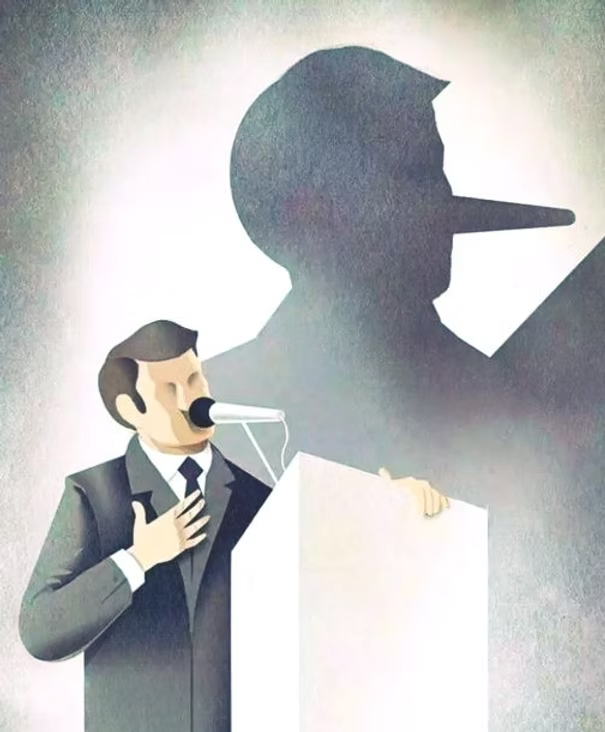
There’s a joke that goes: Why don’t politicians never tell the truth? Because then they’d be out of a job. It’s a cynical punchline, but one that has become so entrenched in our collective consciousness it often feels like a weary acceptance rather than a ques on. And yet, here we are, grappling with an age-old dilemma that seems as relevant now as it was centuries ago: Should politicians ever be punished for lying?
At first glance, the answer might seem obvious — of course they should! Lying erodes trust, breaks social contracts, and leaves ordinary people feeling betrayed. But peel back the layers, and it becomes a ques on drenched in complexity, painted with broad strokes of human nature, politics, power, and the messy reality of governing societies made up of imperfect humans.
So, let’s take a journey. Let’s humanize the ques on, laugh a li le, and get real about what punishment for lying in politics could mean for us all.
The Human Cost of Political Lies
When a politician lies, it’s not just a simple untruth tossed into the wind. It’s a fracture in the foundation of democracy — a betrayal that trickles down and touches the lives of millions.
Imagine a mother in a small town, clutching a letter promising better healthcare for her sick child. That promise came from her elected representative. Now imagine that promise was a lie — a tool used to win votes but abandoned once the election dust se led. The child’s suffering remains, and so does the mother’s broken faith.
This is the true cost of political lying: shattered hope, lost opportunities, and communities disillusioned with the very system meant to serve them. When leaders lie, the consequences ripple outwards like a stone dropped into still water, disturbing the peace and widening the divide between rulers and the ruled.
Punishment, then, is not just about accountability. It’s about restoring dignity and jus ce for those harmed by deceit.
The Fine Art of Political “Spin” — Or Is It Lying?
Before we rush to punish politicians, we must confront a paradox: politicians are expected to spin narratives, emphasize certain truths, and sometimes omit inconvenient facts. That is politics. It’s the dance of persuasion, negotiation, and compromise.
But when does persuasion slip into deception? When does a well-crafted speech cross the line into outright lying?
Take, for example, the classic politician’s defence: “I misspoke.” It’s a phrase as common as coffee breaks in government offices. Is it a genuine error or a clever dodge? The answer often depends on perspective and evidence, and therein lies the trouble.
The gray area between spin and lie is vast. Some lies are blatant — false promises made with full knowledge of their impossibility. Others are shades of truth, twisted for effect, or carefully withheld.
Should all these be punished equally? Probably not. But blatant, harmful lies? Absolutely.
A World Without Political Lies: Is It Possible?
Picture a political world free of lies. A utopia where every word spoken by a leader is a crystal-clear beacon of truth. Would governance be easier? Would trust flourish?
Frankly, it sounds exhausting.
Humans are complicated, and politics even more so. Leaders must navigate compe ng interests, strategic decisions, and yes, sometimes uncomfortable truths. Not every political failure is a lie; some are hard truths we aren’t ready to hear.
Still, the dream of honesty is not naive. It’s necessary.
Without honesty, democracy is a house of cards. Without truth, accountability crumbles. Punishing lies, then, becomes a tool — not of oppression — but of preservation. It keeps the system honest and reminds leaders they serve at the people’s pleasure, not their own whims.
The Problem of Enforcement: How Do You Punish a Lie?
Here’s where it gets tricky. Even if we all agree politicians should be punished for lying, what should that punishment look like?
Should it be jail me? A fine? A forced resignation? Or maybe a lifetime ban from ever speaking in public again ?
Practically, enforcing punishment for lies is fraught with challenges. Who decides what counts as a lie? How do we measure intent? What about political bias? Could punishment become a weapon against dissent rather than a shield for truth?
Some countries have laws against political falsehoods, others don’t. And even where laws exist, enforcement is rare or selective.
This is where humour sneaks in: imagine a court trial where a politician is cross-examined about their “alternative facts” and “creative truths,” and the judge responds, “Sir, your pants are officially on fire.” Would that be justice? Or a circus?
Yet, humour aside, it highlights a serious problem: accountability mechanisms must be fair, transparent, and immune to political gamesmanship.
A Personal Story: Why I Care About Truth in Politics
I remember my friend once telling me, “A lie told often enough becomes the truth in the minds of many.” She was talking about everyday gossip, but the same applies to politics.
Growing up, I saw how political lies affected people around me. A neighbour lost her job after a government official promised investment that never came. A friend’s family suffered when healthcare promises dissolved into empty words.
Those lies were not abstract—they were deeply human, painfully real.
And that’s why I believe politicians should be punished for lying—not out of a desire for revenge, but out of a need to protect people’s lives, hopes, and dignity.
But What About Freedom of Speech?
Some might say punishing politicians for lying infringes on freedom of speech. After all, aren’t they allowed to express opinions, even if unpopular or inconvenient?
Here’s the distinction: freedom of speech protects expression but does not shield deliberate deception that harms the public.
Think of it this way: if a politician says, “I believe the economy will improve,” that’s opinion. But if they say, “The economy is improving,” while hiding data proving the opposite, that’s a lie with real consequences.
Punishment, then, is not about silencing dissent but about maintaining honesty in public discourse.
The Role of the Media and Citizens: Holding Politicians Accountable
Punishment for lying cannot be enforced solely through legal or institutional means. It also requires a vigilant media and an engaged citizenry.
Journalists act as truth detectives, fact-checking claims and exposing lies. Citizens, armed with information, demand accountability through voting, protests, and dialogue.
When the public is informed and active, politicians know their lies have consequences beyond legal punishment—social and political consequences that can end careers.
In this sense, punishment is also cultural and communal: a collective refusal to accept dishonesty.
Conclusion: The Human Need for Truth, Forgiveness, and Justice
So, should politicians ever be punished for lying? Yes. But not in a simplistic, punitive way.
They must be held accountable for lies that harm, for broken promises that cost lives and trust. Punishment must be fair, transparent, and part of a broader commitment to truth in governance.
But let’s remember: politicians are human too. They make mistakes, face impossible pressures, and sometimes, their “lies” are born of fear, ambition, or desperation.
The challenge is balancing justice with empathy. Punishing lies does not mean demanding perfection—it means demanding honesty, responsibility, and respect for the people they serve.
In the end, democracy depends not on perfect leaders, but on vigilant citizens who refuse to accept lies as currency and who laugh at the absurdity of dishonesty while demanding a better, truer world.
~S.S