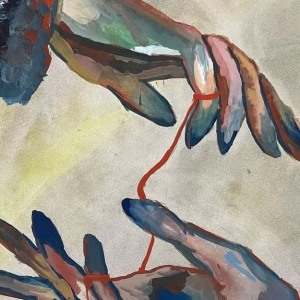
Why Must Motherhood Be Synonymous with Martyrdom?
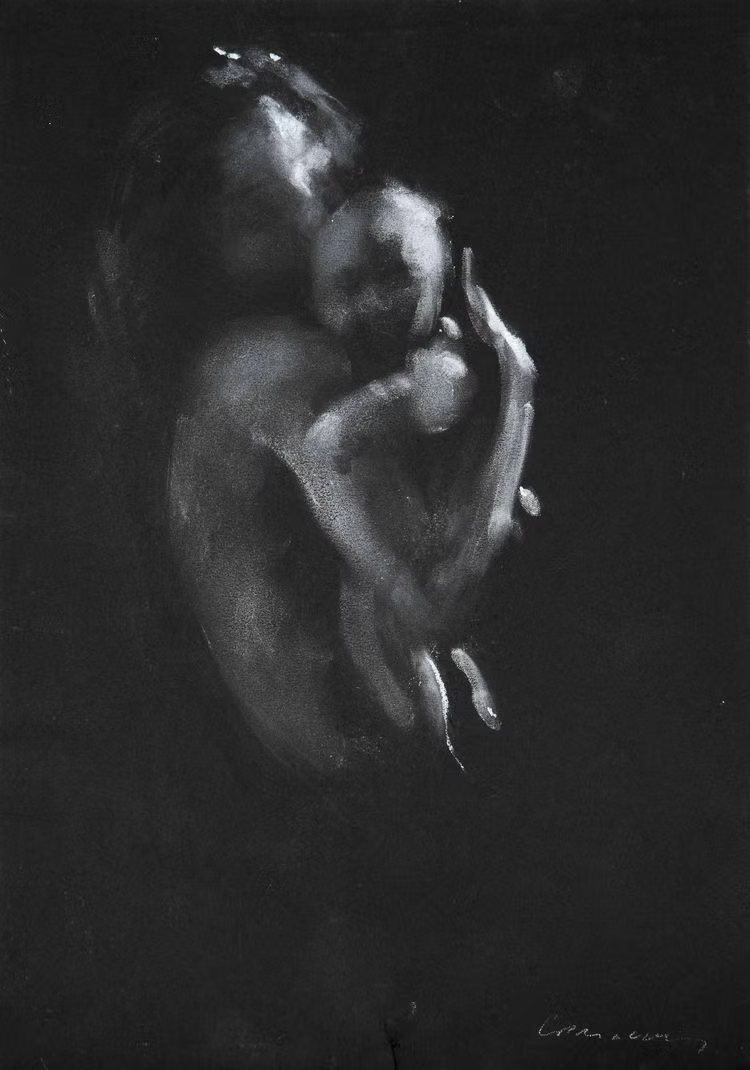
There is a myth stitched into the hem of every sari, every apron, every silent sigh: that a mother must die a little each day to prove she loves. That her bones must ache, her voice must soften, and her dreams must be archived in boxes marked “someday,” gathering dust while she lays her life at the altar of everyone else’s needs. Why must motherhood be synonymous with martyrdom? Who wrote this script, and why has no one dared to rewrite it? We are told from childhood, in lullabies and bedtime stories, that mothers are goddesses—eternal, giving, selfless, serene. Draped in white, eyes full of light, hearts made of honey and hurt. But goddesses, too, have their rage. Their storms are not weaknesses; they are weathered strength.
Have you heard of Kali? She who danced with destruction when injustice dared to breathe too loud? She who wore skulls as garlands, not as trophies, but as warnings. She did not whisper; she howled. And still, they speak of her as the anomaly. The rare one. The dangerous one.
But why?
Why is our image of a mother always kneeling? Always forgiving? Always in surrender, soft-spoken, self-erasing? Why is she not allowed to roar? Why is she not allowed to dance, wildly, for herself?
They speak of Kali as if she is the exception—fierce, unapologetic, wild. But she is not alone. She never was. Across scriptures and civilizations, across temples and torn scrolls, there are women who burned bright and refused to shrink into shadows. There is Durga, mounted on a lion, ten arms outstretched—not for multitasking domestic chores—but for battle, for balance, for justice. There is Athena, goddess of war and wisdom, who strategized cities and split skulls with a spear. There is Lilith, the first woman in some telling, banished not for sin but for the sacred act of saying “no.” She would not lie beneath him. So she became a monster in their stories, when all she did was want to stand tall. And there is Mary.
Yes, the virgin mother, so often painted in pale blues and quiet suffering, made to embody meekness. But what they forget is that she, too, was steel beneath the softness. She was not merely a vessel. She bore the impossible, carried prophecy in her womb, bore the son who would be crucified, and still stood at Golgotha. Not weeping behind closed doors, but standing—present—as the nails were driven in, as the sky turned black. Her silence was not submission; it was sacred defiance. She did not crumble. She watched her child murdered by empire, and still believed in mercy. The world painted her as porcelain, but Mary was iron. Then there is Fatima, the luminous daughter of Muhammad—not soft as silk, but strong as stone. Her spine was a poem of pain and prophecy. Her grief shaped empires. In Africa’s ancestral songs, we find Yemọja, the orisha of oceans, of motherhood, aging, radiant, weeping salt and magic. She is not docile. She is tide and thunder. In East Asia, there is Guanyin, the bodhisattva of compassion, but hers is a compassion carved by strength, not surrender. She watches over the cries of the world, not because she has nothing else, but because she chose that path with open eyes. Still, despite all this divine diversity, all these stories of rage wrapped in silk, of love forged in fire, the world tells today’s mother that to be holy is to be hollowed out. That to be sacred is to suffer. That to be a “good” mother is to be an uncomplaining corpse with a warm heart. It is as if we pluck only the parts of these women that suit our narrative , keep their patience, erase their rebellion, sell their silence like incense in a temple of obedience. But no more. Return them their swords, their scrolls, their roar. Let them reclaim the fire we buried beneath duty. Let them be full epics again—not verses misquoted, not prayers without power. These goddesses were never meant to be footnotes to men. They were entire scriptures of blood and brilliance. They were storms dressed in divinity. And so are our mothers. You see, the world worships mothers the way it worships monuments: from a distance, in silence, and only after they have crumbled under the weight of everyone else’s expectations. Flowers are placed at their feet not while they are living, breathing, aching, but when they have already been reduced to stone.
She is praised when she forgets herself. She is adored when she disappears—bit by bit—into the lives of others. The more she erases her own name, the more the world speaks hers. She is called “noble” for silencing her dreams, “graceful” for staying quiet when her heart screams in want. What kind of cruel arithmetic is this, where a woman gains worth only as she loses parts of herself? Where her love is measured by how little of her remains? Where her value is calculated not in what she creates, but in what she surrenders?
It starts early. The girl who once painted galaxies on her school notebooks, who dreamt of flying machines or writing novels or climbing the Himalayas, is handed a new set of dreams when she becomes a mother. Dreams that don’t belong to her. She is told, not in so many words but in sighs and sideways glances, “You’re a mother now. This is your purpose.” And when she asks, “Can I be more?” ,the world says, “How dare you be ungrateful?” She wanted to audition for that play. But the baby had a fever and no one else offered to stay. She was shortlisted for a scholarship abroad, but her in-laws said it wasn’t “respectable” for a mother to leave her child. She muted the notification from her writing group because dinner wasn’t going to cook itself. She sat in classrooms meant for her child and smiled at teachers who never knew she once wanted to be one herself. Her hands used to be full of color. Now they carry grocery bags and the weight of everyone else’s expectations. And when she dares to whisper her fatigue, to speak of her fading dreams, she is told, “You chose this life.” As if she chose to be erased. As if the universe sat her down and offered her freedom and motherhood, and she signed away one for the other.
No.
She was taught to believe they could never coexist. That love is proven by forfeiture. That ambition is selfish. That the only noble woman is the one who burns quietly, who folds her wings so her children may fly. But tell me—why must a woman’s light be dimmed for others to shine? Why must she be punished for remembering who she used to be? The Persian poets wrote of longing so vividly it bled onto their skin, soaked through their verses, and watered the roses of grief. Hafez wrote of the wine of freedom, Rumi of the dance of the soul—and I wonder, if they stood among us now, would they recognize the quiet despair behind a mother’s smile? Would they still call it divine when her dreams are wrapped in silence and buried beneath diapers, deadlines, and dinner? Or would they lower their gaze in sorrow, kiss her tired hands, and mourn her captivity with couplets of fire? Would they write of the woman who once spun constellations with her words, now stitching wounds into her silence while the world claps for her endurance? Would they still call it love, this slow erasure in the name of duty? Or would they call it what it truly is , a holy woman chained in invisible gold, her suffering romanticized until she forgets it ever hurt? Rumi might whisper, “Why do you stay in prison, when the door is wide open?” , and yet, here she is, praised for how beautifully she suffers, how gracefully she disappears.A mother cooks not just meals but apologies, serves not just tea but explanations, carries not just children but the weight of generations. And she is expected to do so with a smile, as though joy can be demanded the way laundry is. “You signed up for this,” they say. As if she signed up for invisibility. As if she chose to be loved only for what she gives, and never for what she is. She is a woman first. Why do we forget that?
Before the stretch marks, before the lullabies, before the nights that blurred into mornings and the clothes stained with milk and silence , she was a woman. A woman with dreams sharp enough to cut through glass ceilings. She had songs in her throat, maps in her palms, wild plans and quiet prayers. And even now, somewhere between diaper changes and doctor’s appointments, that woman still breathes. Faintly, maybe. But she’s there. She writes poetry in her mind while stirring soup on the stove. She imagines other lives while tying shoelaces and wiping away crumbs. Her heart beats to the rhythm of two worlds—the one she lives in, and the one she left behind. But the world would rather she forget.
It claps when she endures but turns away when she aches. It hands her badges for surviving, but never asks what she’s lost. They call her “supermom” when she does it all—but flinch when she says, “I’m tired.” God forbid she says, “I miss myself.” That, it seems, is too dangerous. Too selfish. Too human. Because in the temple of motherhood, sorrow is sacrilege. And longing is betrayal. Let me ask you—why is a man celebrated for changing one diaper, but a woman is shamed if she dares to ask for help?
Why is fatherhood seen as participation, but motherhood is obligation? We romanticize her pain. We glorify her selflessness. We write poems about her sacrifice. But do we ever stop to ask—did she want this? Did she have a choice? Or did the world corner her into compliance and wrap it in pretty ribbons, calling it destiny? And here’s the part that chokes me , when she tries to break free, when she says, “I want something more,” she is called selfish. As if the word “mother” is a cage and “woman” is the escape route society dares not name. She is not allowed to have bad days. If she cries, she is weak. If she complains, she is ungrateful. If she walks away, God forbid, she is a monster. Because in this world, a mother’s love must be unconditional, but the love she receives is laced with conditions. Even religion, in its own way, has become a silent accomplice. “Heaven lies at the feet of your mother,” they say. And yet, no one bends to kiss those feet when they are cracked and calloused from walking through fire every day.
No one sees the blisters hidden beneath her sandals. No one notices the tremble in her steps. We glorify her journey, but never offer her a place to rest. They speak of heaven as her reward, but no one ever asks: Who built the heaven she’s supposed to lead us to? Whose hands laid its bricks while her own body ached? Whose joy was bartered so we could have peace? Who swallowed dreams like bitter pills so we could sleep easy? She gave us comfort while sitting in discomfort. She lit lamps while standing in darkness. She gave us faith even on days she had none left for herself. And yet, the world rarely stops to ask, “What did she have to give up to become the one we worship?” What parts of her soul were traded for our salvation? What pieces of her were chipped away, quietly, until only the silhouette of devotion remained? We call her holy, but offer no sanctuary.
We quote scripture about her worth, but ignore her pain.
And in doing so, we make martyrs out of the very women we should have saved.
She is not immortal. She is not invincible. She bleeds, she breaks, she doubts. But we cover her fragility with layers of forced admiration, until she is trapped beneath the very pedestal we put her on. We turn her into a symbol. But symbols don’t eat cold dinners standing at the kitchen counter after everyone else is fed. Symbols don’t cry in the bathroom with the tap running so no one hears. Symbols don’t press their faces into pillows at night and scream without sound. And so, she begins to believe that love is sacrifice. That to be worthy, she must give until there is nothing left.
But I refuse to believe that love must cost her everything.
I want to live in a world where a mother is allowed to be selfish—unapologetically, gloriously selfish. Where she can say, “Not today,” and not be crucified for it. A world where she is allowed to rest without guilt, to dream without shame, to rage without being told she’s unstable. Where she can leave the dishes in the sink and still be called a good mother. Where she can chase the sun for herself and not always for someone else. I want to live in a world where her worth is not measured in meals cooked, messes cleaned, or tears swallowed behind locked doors. Where her value isn’t pinned to the number of sacrifices she’s made or how silently she made them. Where her name is not erased and replaced with “someone’s mom” the moment she gives life.
I want a world where her body is hers—still hers—even after childbirth. Where stretch marks are not shameful but sacred, and still do not define her entirety. Where her career choices are not seen as betrayal. Where her voice isn’t softened to keep the peace. Where her past, her fire, her hunger, her identity , are allowed to stay. I want her to be a woman first. And a mother, gloriously, afterward.
Because , why must she always be the one to stay behind? Why is it always her who watches dreams disappear from train windows while waving with a brave smile? Why must she be the one to dim her light just so others can shine brighter—like some invisible sun? This isn’t love. Not the way God intended it. Martyrdom is not love. It is not a rite of passage,it is a theft. A slow, silent robbery of time, of joy, of the woman she used to be. Love does not demand a burial. Love does not ask you to disappear. We must stop equating exhaustion with excellence. We must stop applauding her bruises and calling it devotion. We must stop handing her halos when what she really needs is help, a hand, a quiet room, an honest conversation, a night of sleep.
Let her rest. Please, let her rest. Let her dream dreams that are not shaped by grocery lists and report cards. Let her write poems that are not just lullabies but war songs and resurrection songs. Let her go back to school at forty if she wants. Or start painting again. Or open that café she always talked about when she thought no one was listening. Let her dance barefoot, not because it’s cute for the kids, but because her feet ache to feel the earth again. Let her chase sunsets, not for the perfect family photo, but because that shade of orange reminds her of a younger version of herself she still hopes to find. Let her be more than a memory in the shape of a mother.
Let her be alive. Fully, tenderly, stubbornly alive.
She was never meant to be the cross on which everyone else’s comfort was crucified. She is not the lamb. She is not the altar. She is the flame, the sacred fire they built their homes around, then forgot about. For every woman who carried the weight of motherhood and slowly forgot the sound of her own name, I see you. For every woman who woke at 3 AM, not just to check on a fevered child but to ask the ceiling if she’s still allowed to dream, I hear you. For every mother who has whispered into the stillness, “I am not okay,” and feared it made her less holy, I stand beside you. Because love should not look like disappearance.
Because motherhood should never be a quiet funeral for the woman she used to be.
Because sacrifice without witness is not sacred, it is sorrow dressed in silence And so, I do not rage at mothers.I rage at the myths. At the stories carved into cradle songs and scripture, where the mother is praised for how beautifully she burns. I rage at the centuries that turned her devotion into a demand, her softness into submission, her giving into a grave. Let us write new stories. Let us build a new scripture,one where the mother is not a ghost in her own life, but the author of it. One where her ambition is not betrayal, her tears not weakness, her longing not shameful. One where her children grow up not just knowing they were deeply loved,but knowing their mother was a person too. A woman who stayed not because she had to, but because she chose to,without having to vanish in the process. One where love does not ask her to disappear to be worthy. One where we stop carving halos and start building homes where she can breathe. One where motherhood is not a martyrdom, but a melody, one she gets to sing in her own voice. And maybe—just maybe—the world becomes gentler when we stop worshipping her only after she’s worn down to nothing, and start honouring her while she’s still here, still human, still whole.